
In a remarkable endeavour that spans the heart of Tribland, Anglian Water’s ground-breaking water main network project has recently unveiled a surprising connection to the past. As pipes are being laid for a colossal 90km pipeline, linking Grantham to Downham Market, a truly captivating piece of history has emerged from beneath the soil.
Tribland residents in Maxey, Etton, Glinton, and Northborough are witnessing the construction’s significant impact on their surroundings. Vast fields are transformed into worksites, and new speed restrictions have been introduced to ensure safety and efficiency.
A monumental effort, both in scale and significance, it is one of Europe’s most ambitious environmental initiatives and marks the UK’s most significant drinking water project in decades. Extending underground across hundreds of kilometres, interconnecting pipelines are weaving a hydrological web from Elsham in North Lincolnshire to the regions of Essex and Suffolk. The overarching purpose is to transport water from areas of abundance to those more parched, offering a solution to water scarcity and drought risk that has long loomed over the east of England.
Once operational, this intricate network will facilitate the daily movement of an astonishing 265 million litres of water. This substantial flow is poised to safeguard the region against the looming threat of drought, a crucial endeavour for a region known for both its dry climate and its rapidly growing population. However, beyond the engineering marvel, Anglian Water is determined to leave behind an enduring legacy for both the environment and the communities along the route.
Project manager Glenn Harvey underscores the importance of this initiative, noting that the east of England harbours the dual challenge of being one of the driest regions in the UK while also experiencing rapid population growth. He explains, “Our investment and efforts mirror the gravity of the challenge. After years of meticulous planning, we are now taking tangible steps to enhance water resilience and ensure a sustainable future for this region.”
Harvey adds, “Without the new water main grid, the demand for water could potentially surpass supply as early as 2030.”
The work is having a huge impact on landowners – and particularly farmers across the area with swatches of acreage being swallowed up to the pipeline work.


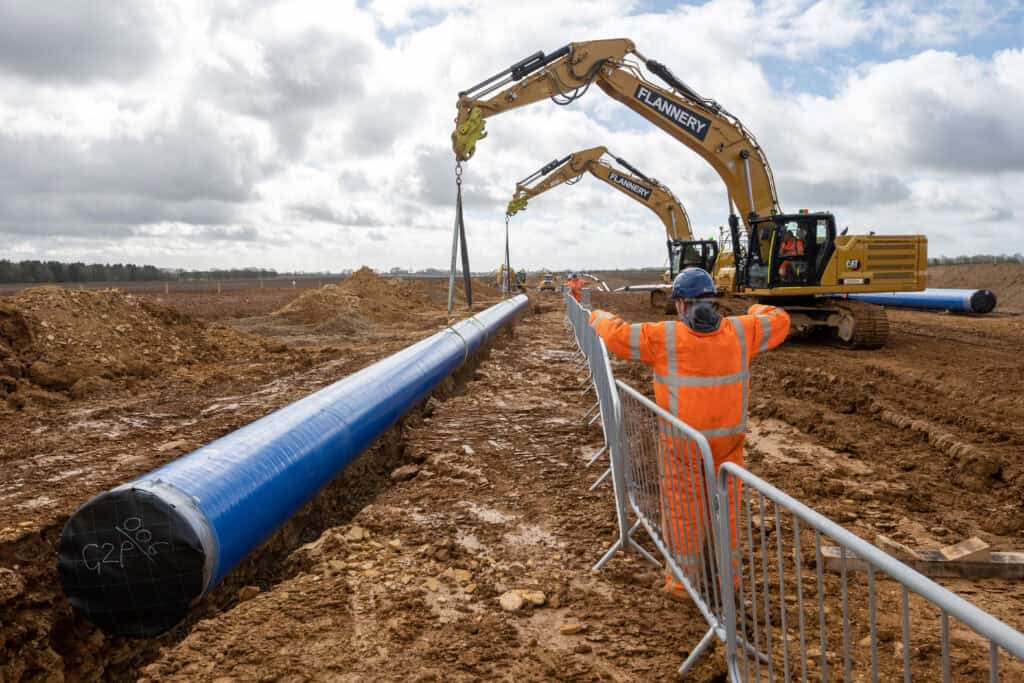
Farmers are likely to have smaller fields for the next two years at least while the construction work is carried out. In places the pipeline is also being pulled underground to avoid roads being disrupted by drilling under the surface. This has been particularly evident around Glinton, Maxey and Etton with large compounds being created.
Anglian Water is taking drone shots of the sites ‘before’ the work so they can ensure that restoration in about two years time will be as close as possible to the sites as they are now..
The pipeline work will also go through the eastern side of Langdyke Countryside Trust’s Etton Maxey Reserve. One planner described the reserve as one of the most important in the Peterborough area,
Negotiations between the Trust and AW mean that the impact on nature on the site – and elsewhere on the route – is being kept to a minimum with constant monitoring to ensure as little damage to the eco system as possible.
For instance on the Etton Maxey Reserve conservation work has been carried out to move areas of turf which contain field bindweed – used by the rare four-spotted moth that inhabits the reserve and the nearby Maxey Cut. It is hoped that this will mean the survival of the moth.
The work has also been held up to ensure the breeding season of the threatened Turtle Dove is not disrupted. Langdyke volunteers regularly put out supplementary feed for the birds on the reserve to help them and a number of young birds have been seen on the site this summer as a result..
Anticipation is building as the new grid is scheduled for operation in 2025. However, amidst this modern marvel, an unexpected twist has captured the imagination of both historians and locals. During the construction of the water main network, archaeologists stumbled upon a remarkably preserved artefact, shrouded in history and mystery alike.
An ancient jug, believed to date back almost two millennia, has been uncovered during the preparations for this ambitious water project. Experts speculate that this well-preserved vessel served as a “votive offering” – a gesture to curry favour with the gods, according to “Romano-British” traditions. Prior to its possible divine intentions, the burnished jug likely functioned as an oil storage container.
Excavated from Tribland, the discovery included two intact copper rings and a decorative pin, each offering a glimpse into the craftsmanship of its era. One ring even retains traces of its original enamel. Experts classify the rings as “late Roman,” and the accompanying coins are thought to hail from the third or fourth centuries, a testament to the rich historical tapestry that lies beneath our feet.
As the water main project marches forward, it serves as a conduit for more than just water – it brings to light a hidden connection between the past and present, reminding us that the very ground we walk upon holds secrets waiting to be unveiled. In Tribland, history and innovation coalesce, creating a narrative that bridges the ages and enriches the community’s story.


