
Water plays an integral part in all of the world’s major religions including Christianity. It symbolises cleansing, the washing away of sins and new beginnings. Jesus started the Christian tradition when he invited his cousin, John, to baptise him in the river Jordan. Thus, the sacrament of baptism represents initiation into the Christian faith, which explains why fonts were originally placed near the church’s main entrance, usually the south door. Alas! They are often overlooked by architectural historians, including the esteemed Nikolaus Pevsner. Yet, most fonts are unique and many have interesting backstories.

When Constantine the Great declared Christianity as the official state religion of the Roman Empire in 312AD, it included the province of Britannia too. This is corroborated by the discovery of a lead baptismal tank at Ashton, near Oundle, and the so-called Water Newton Treasure, a hoard of silver artefacts bearing the Christian chy-rho motif, buried across the River Nene from Castor.
Obviously, the first Christian converts were adults who were ‘christened’ in a convenient river or bath-house, where total submersion was practised (as in the Baptist church today). After the departure of the Romans, religion was no longer regulated and, although pockets of Christianity may have lingered, the majority of the indigenous population and Anglo-Saxon incomers were pagans.
During the late-sixth and early-seventh century, Britain was re-evangelised. The twelfth-century Peterborough historian, Hugh Candidus, intimates that when missionaries arrived in our area, c.654, converts were ‘dunked’ in the cold waters of the river Nene, close to a sacred spring, called the Medeswell, which fed a fathomless pool. Indeed, the word ‘font’ is derived from the Latin fons, meaning ‘spring’.
Once the abbey (known as Medeshamstede) was built these precarious practices ceased and the ritual was performed indoors. On the Continent, cathedrals like Florence, Pisa, Poitiers and Aachen were constructed with detached baptistries, on the principle that no one could enter the church itself – or the kingdom of Heaven – until they were ‘christened’. Although there may have been a separate baptistry in Canterbury, most of the population in Britain lived in dispersed communities. Therefore, it was easier for converts to travel to the nearest ‘mother church’ where a baptismal font was installed.
The first Anglo-Saxon fonts were carved from wood, which tended to rot, so they were gradually replaced with stone. The Anglo-Saxon and early-Norman ones at Deerhurst [Gloucestershire] and St Martin’s Canterbury are so deep that we may conclude that the participants climbed in to be partially immersed and water was poured over them. During the twelfth-century, immersion was supplanted by aspersion [the sprinkling of water over heads] and the bowls became shallower.
Moreover, since the infant mortality rate was high, the baptism of newborns was de rigueur.
During the ceremony, the north of ‘Devil’s door’ was opened (a custom still maintained today in some churches) so that evil spirits lurking within could be expelled. Thus, a bawling baby was considered a good omen, heralding an obedient childhood and a virtuous adult life.

Fonts were always covered when not in use. Holy water, blessed by the priest, remained within the lead-lining to serve several baptisms and was only changed when it became stagnant. So, there was a danger that it may be stolen for magical purposes or devil worship.
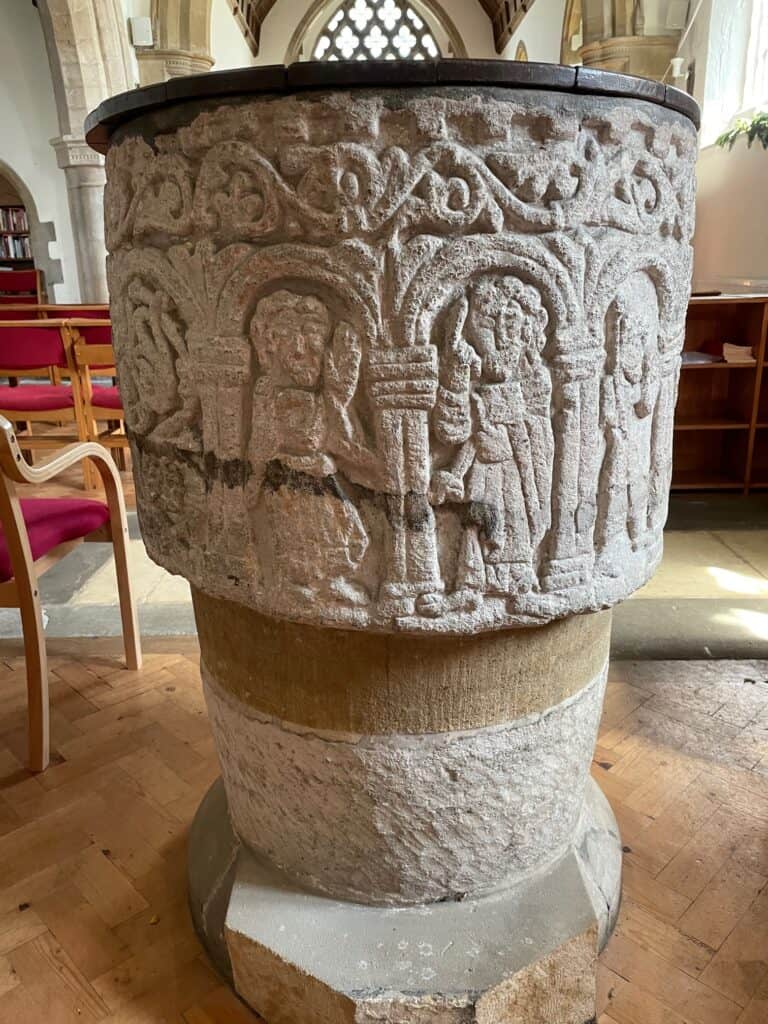
The oldest extant font in our region is at Wansford. This ornate early-twelfth-century Romanesque [Norman] survivor, was discarded when Sibberton chapel was demolished and redeployed as a cattle trough until it was rescued and raised on a new plinth at St Mary’s, in 1902. The font at Castor, of slightly later date, has also been in the wars. It was evicted by Cromwell’s troops in the 1640s, smashed to pieces and left outside the north door, until it was reinstated in 1928.
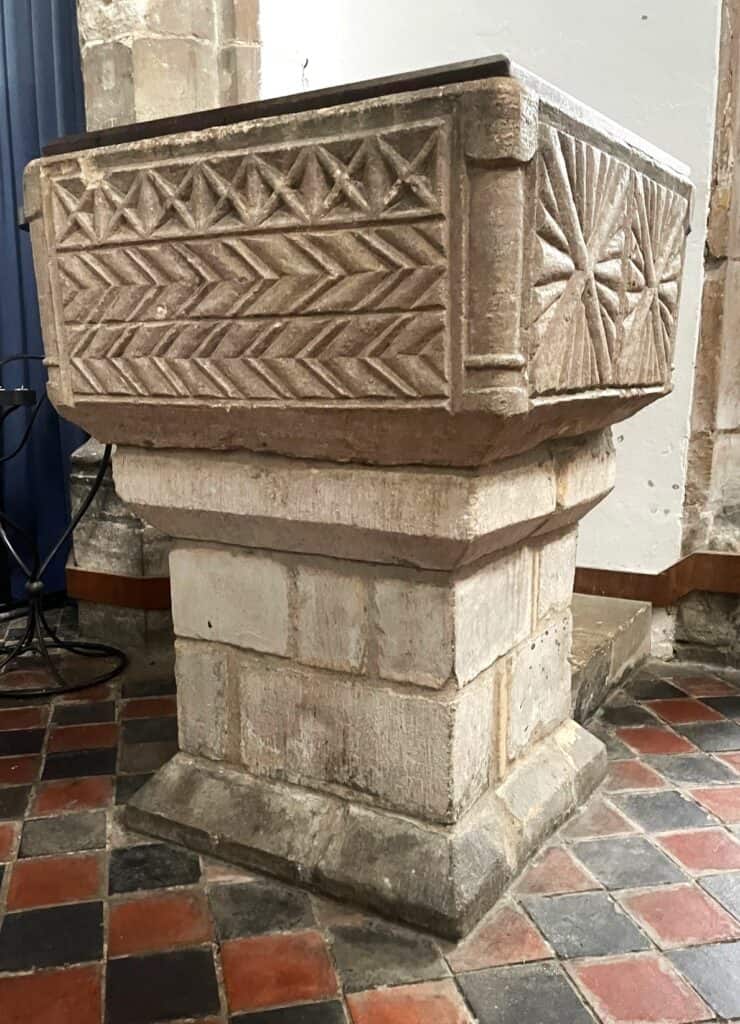

Another Romanesque font, with exquisite geometric carvings, graces Glinton church. Recently, an Ambler friend pointed out the similarity between its design and the tympanum above St Pega’s door at Peakirk. This made me speculate why the ‘mother church’ at Peakirk had a humbler fourteenth-century counterpart than its chapel-of-ease at Glinton. Had it been removed by some abbot of Peterborough attempting to elevate Glinton’s status as a manorial centre? Of course, we can’t prove this, but I would bet my bottom dollar that the Glinton font and Peakirk tympanum were crafted by the same sculptor!
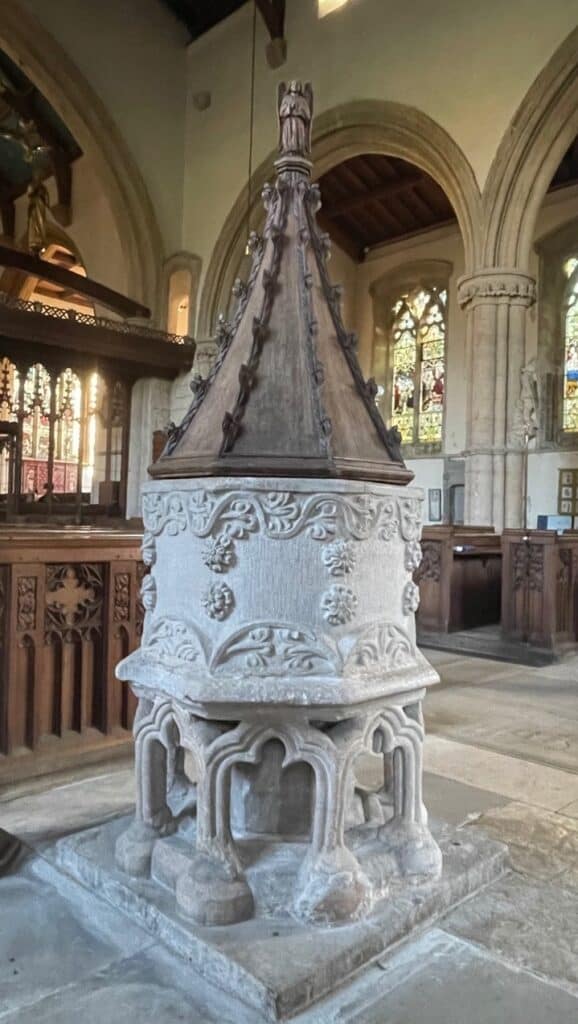

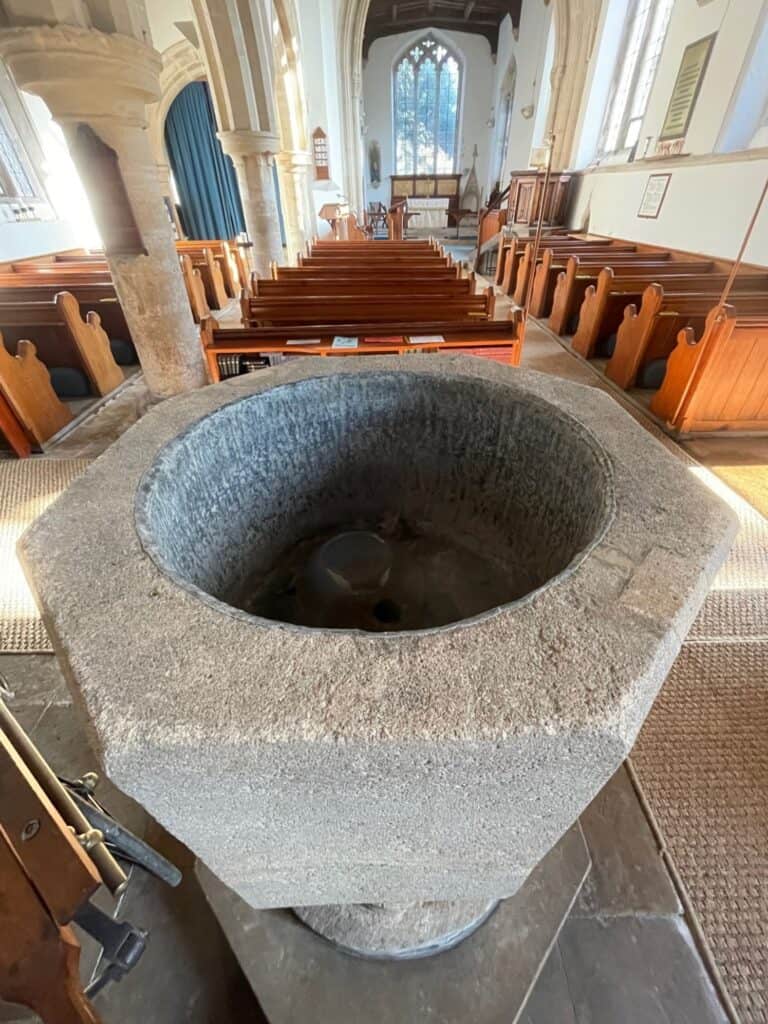
Barnack’s font is a bit of an enigma too. Its elaborate plinth and decoration belong to the thirteenth-century, yet the bowl is deep enough to have at least twelfth-century origins. It was relocated to its present site, near the north door, in 1853, during Reverend Canon Marsham Argles’s renovations. Other fine examples of thirteen-century pedestaled fonts are at Bainton and Sutton.
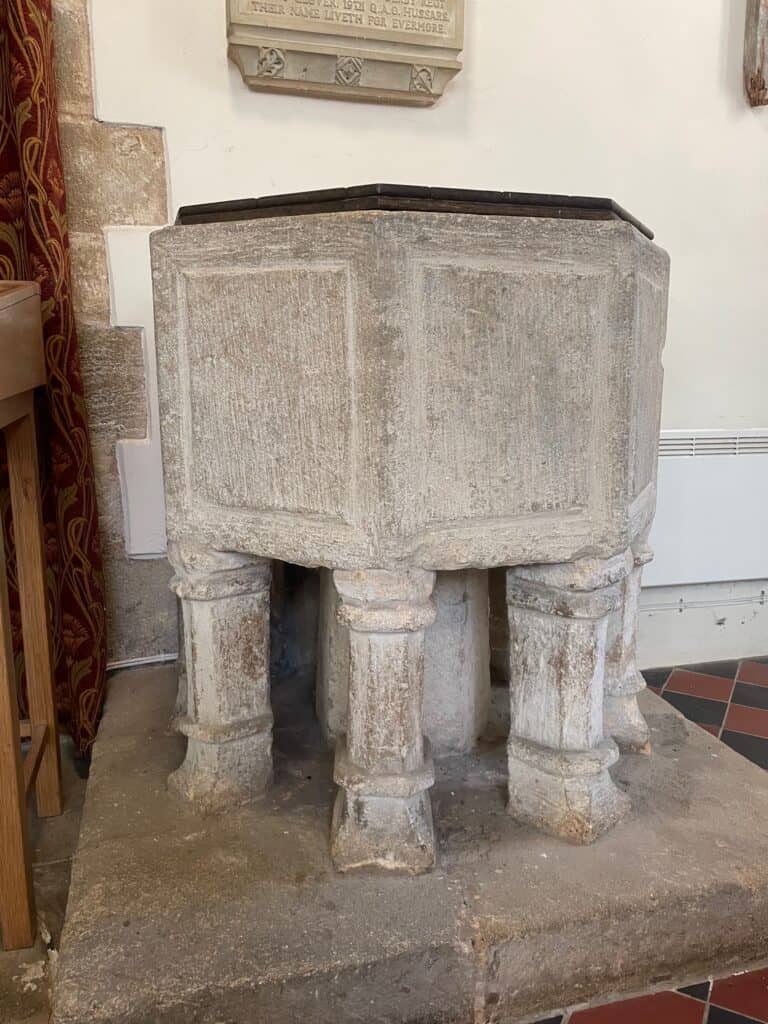


The ultra-plain early-fourteenth-century utilitarian fonts at Etton, Helpston and Peakirk reflect a period of recession followed by depression: harsh winters; wet summers; failed crops; pestilence among animals; famine and ultimately the Black Death. At the same time, there was an epidemic of wall-paintings in Tribland, and beyond, especially ‘Morality Tales’ and scenes from Judgement Day, as a reminder to congregations that death could strike when least expected. In contrast, Ufford’s graceful fifteenth century perpendicular font is uplifting in more ways than one, for it has a step to allow easy access.
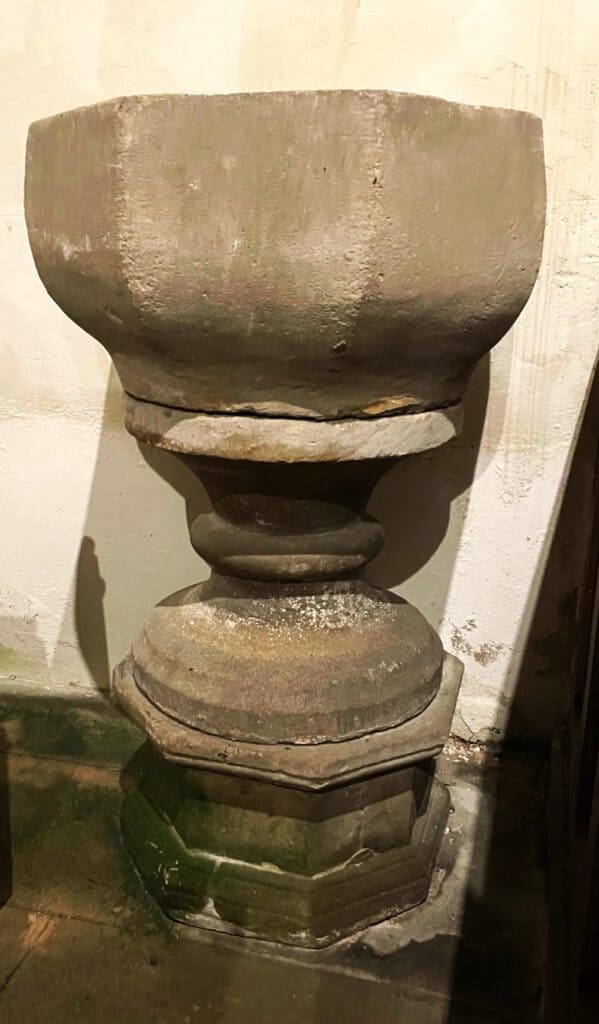
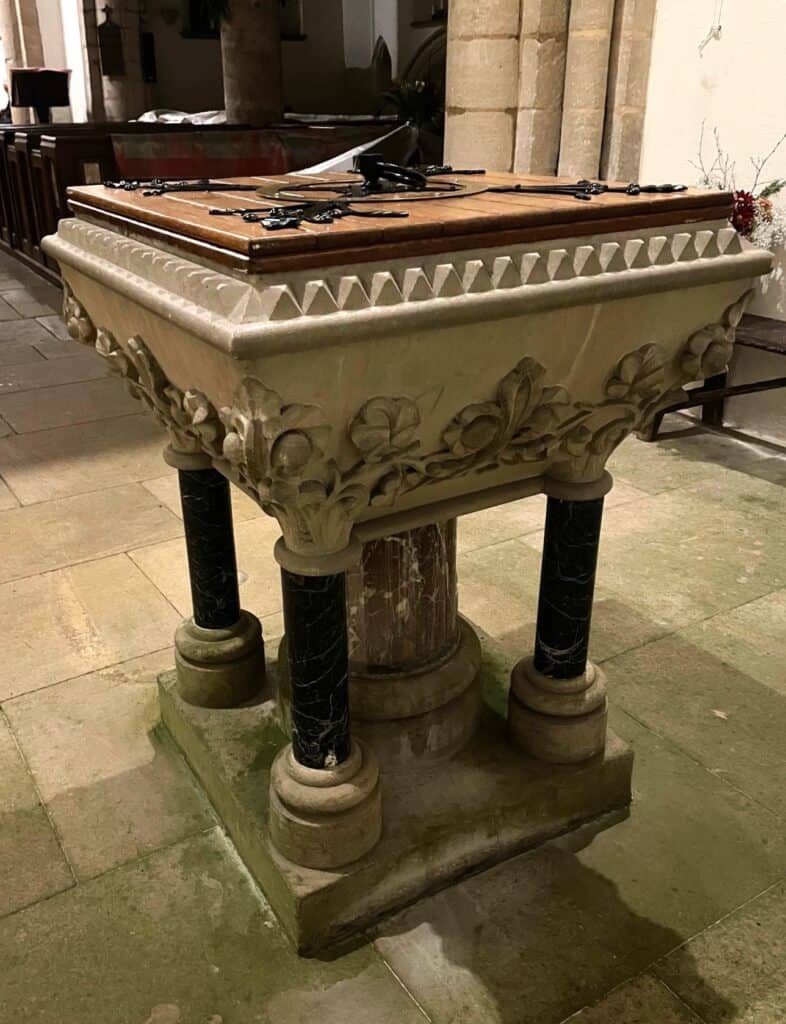
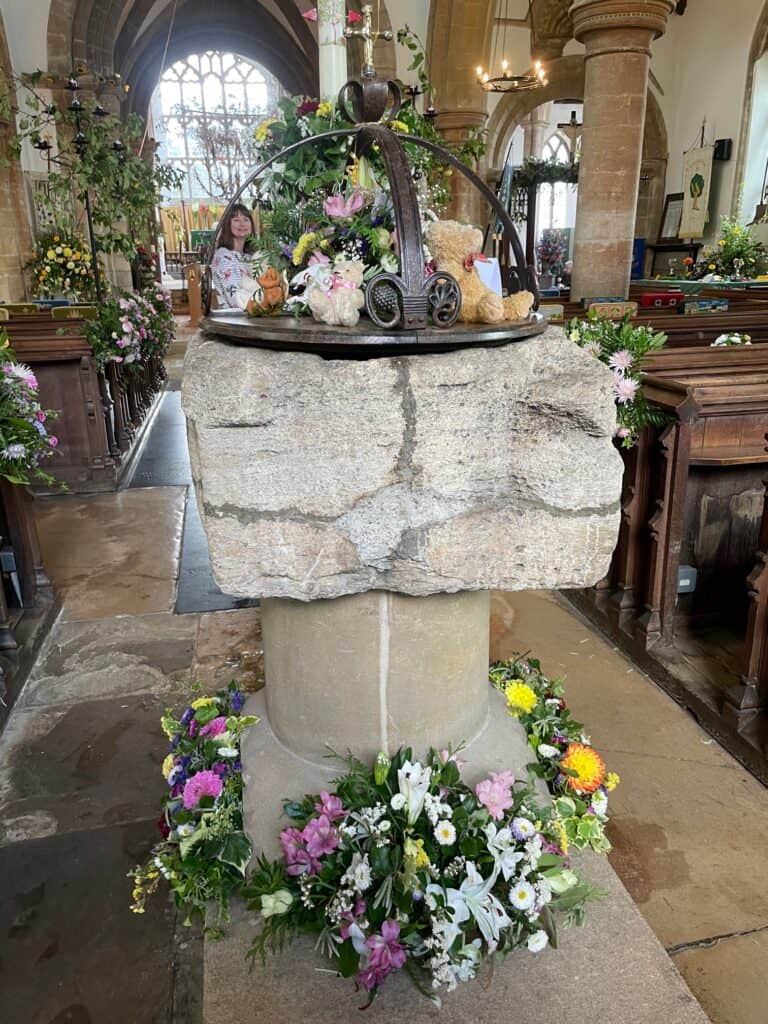
Maxey is blessed with two fonts, both relatively modern, which makes us wonder what happened to their medieval predecessor. An elegant, cup-shaped, post-Reformation variety was relegated to a corner of the north aisle, when Reverend Canon Argles and his wife Margaret (née Davys) sponsored a lavish replacement set on marble columns, in memory of his father-in-law, George Davys, Bishop of Peterborough (1839-64), who had appointed him Rector of Barnack, in 1851.
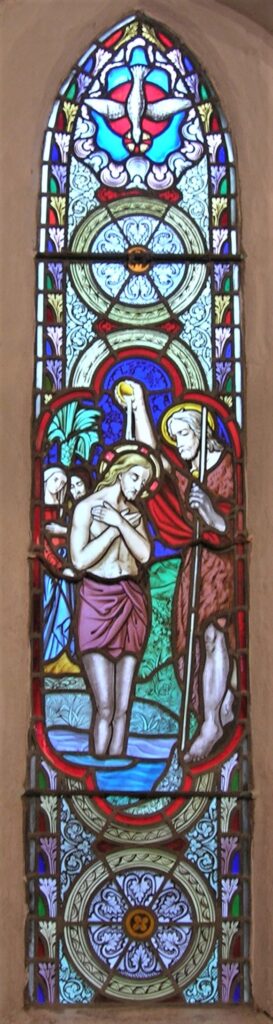
Perhaps, of all Tribland’s fonts, only Castor’s, Glinton’s and Ufford’s remain in their original locations. After the north and south aisles had been added, most found themselves some distance from the main entrance. Bainton’s, Barnack’s, Helpston’s, Maxey’s and Sutton’s have since been moved to less-obstructive and more user-friendly positions. However, Peakirk’s font has been re-sited close to the south door, beneath a Victorian stained-glass window depicting Christ’s baptism by John in the river Jordan, which is exactly where our story began.


