
Aviation enthusiast Brian Cocks gives Clair Wordsworth a tour of his extensive Tribland bookcases, in the first in a new series of features.


“If I go into a house and there are no books, I find it unnerving,” says Brian Cocks, “I wonder what makes them tick!” Brian is a retired bookdealer, a second career that got started in the mid-1980s, after (ironically) an American executive flew to Blighty to close the department at Perkins Engines in Peterborough where Brian was employed. After a couple of false starts at other things, he slowly turned his long-term hobby of collecting books about aviation into a reliable business. This just goes to show, one should always try to stay positive during dark times.
Brian had joined Perkins in 1952, as a Planning Engineer, after completing his obligatory two years of National Service in the Royal Electrical & Mechanical Engineers. “Terribly boring,” is how Brian describes his period of National Service today. “As the famous joke has it, you stood about and if anything moved, you saluted it, if not, you painted it white! It was a dreadful waste of time. I didn’t go anywhere interesting or do anything notable. I couldn’t wait to start work.”

When Brian joined Perkins in the early Fifties, he owned a Norton ES2 motorcycle (pictured). Before finding a permanent home in Tribland, he rented rooms in Peterborough and commuted on some weekends to and from Surrey by motorcycle. Crash helmets were not compulsory back then – they wouldn’t be until 1972 – so, he generally just wore a cloth cap during the 100-mile trips. He chuckles at the memory of this today.
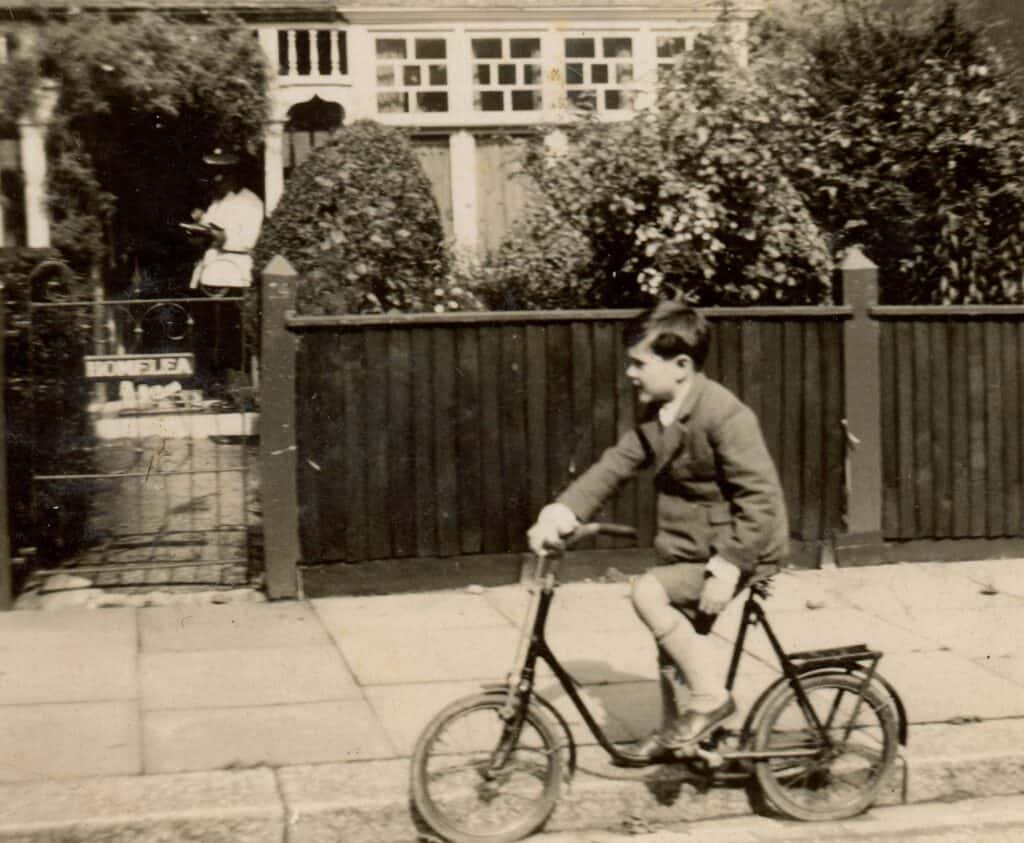
As a boy, growing up during the Second World War, Brian quickly became fascinated by the planes he saw flying in the sky and others he glimpsed over the wall of Tangmere Aerodrome, from the top deck of a bus, on his way to school. “Tangmere was one of the biggest, most important aerodromes in the south of England at that time,” he recalls, “there were exciting aeroplanes there just the other side of the fence. Once, I cycled down with a girl from the village and one of the guards said, ‘Come on kids. Come and sit in this Spitfire.’ It was a great excitement, to climb into a Spitfire that was almost certainly going to be used in action the next day!” Brian’s face lights up. All these years later, he finds the memory of this childhood event uplifting and its infectious. “Officially there was a great sense of secrecy around the aerodrome, but we were school kids and the guard thought we’d enjoy the experience, so we were very lucky!”

Along with many of his school friends, Brian was an avid reader of the magazine Aeroplane Spotter, published between 1941 and 1948. Each issue contained 12 pages of news, features, photos and silhouettes (pictured) of the era’s major aircraft. Naturally, a few details were omitted for security reasons. And, you’ll be delighted to hear Brian still has a complete collection of those coveted boyhood magazines!
There was also a dedicated Spotters’ Club at Brian’s school, “we took a great deal of pride in identifying everything that flew.” The physics teacher was a member of the local Observer Corps, a civil defence organisation dedicated to the visual detection, identification and reporting of aircraft over Great Britain, so Brian could usually get answers to his most pressing questions, although sometimes he was told, “that’s top secret”
Given Brian’s early fascination with planes, it’s initially surprising to discover that Biggles books didn’t feature in his childhood reading at all. Yet, speaking to him, I’m enlightened quickly as to why, “you didn’t read fiction, because wartime was far more dangerous and exciting.” So, the stories by W. E. Johns (1893-1968) about James Bigglesworth, the fictional pilot spanning both World Wars, were not on Brian’s RADAR until much later.


W. E. Johns had been a pilot in the First World War and remained in the RAF until 1927. His other stories include a series of books about Flight Officer Joan Worralson (plucky fictional member of the WAAF) and another series about a British Army commando. W. E. Johns also edited ‘Popular Flying’ magazine and publication about gardening. He was something of a workaholic says Brian.
Brian Cocks remains curious and continues to find new areas of interest. Books about early ballooning currently fascinate him. And, he’s proud to have been up in a balloon three times. “A beautiful sensation of silence,” is how he describes the experience. “You can hear what people are saying 100-200 feet below.”
Apparently, right from the start, there were two distinct types of balloon flight – one using hot air, another using hydrogen. The French were the leading pioneers of ballooning. And, the first successful human balloon flight took place in France in 1784, using hot air. In those early days, it was an exceptionally dangerous pastime. Parachutes were available, but it would take over 100 years for safety issues with them to be mostly ironed out.

A few of shelves are dedicated to female aviation pioneers, such as Amy Johnson, Jean Batten, Amelia Earheart and Pauline Gower. Amy Johnson (1903-1941) became the first woman to fly solo from England to Australia in 1930 and was dubbed Queen of the Air by the British press. She died in action in World War II, whilst delivering a new aircraft, as a member of the women’s branch of the Air Transport Auxiliary service, set up by Pauline Gower (1910-1947).
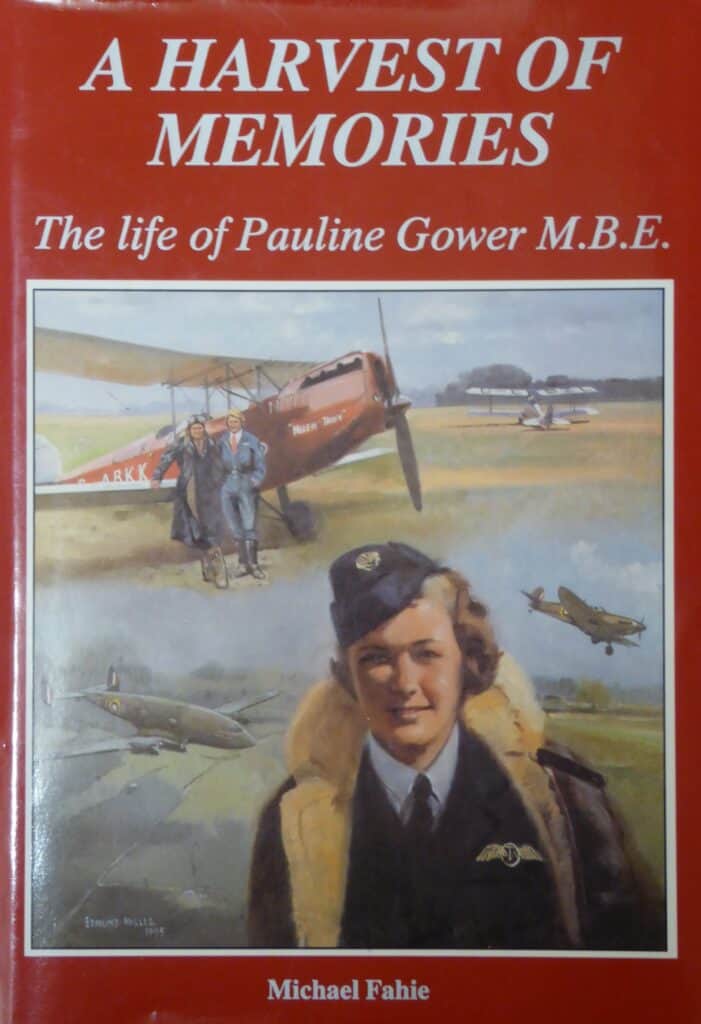
Brian has a notable connection to Pauline Gower. After surviving the Second World War, Pauline tragically died in March 1947, after giving birth to twin boys. Sometime later, Brian came across the original telegram giving the news of this unique life/death event, it reads: “Pauline died last night. Twin sons survived and are well.” Brian has since been able to pass that telegram on to one of Pauline’s sons. Michael Fahie wanted to write a book about his mother, whom he knew little about. Out of the blue, Brian got a phone call from Michael and was able to assist him getting a publisher. The book, A Harvest of Memories: The Life of Pauline Gower M.B.E. was the result (pictured).
“One of the best things about being a book dealer was meeting very interesting people,” Brian says. Fighter Pilot Johnnie Johnson (1915-2001) was one of the most memorable, “meeting him at his house in Derbyshire was a real highlight. He was quite a character. Very abrupt, but friendly.” Johnnie Johnson was the most successful British Fighter Pilot of World War II in terms of enemy planes shot down. His book Wing Leader was a best seller.
“War flying probably attracts the greatest interest of all,” says Brian authoritatively, “it’s probably responsible for more printed words than any other aviation subject.” He points out that our victory in the Battle of Britain could so easily have ended in defeat. Hitler had more than enough planes to wipe out the RAF completely, but Britain’s preparation in 1938/9 (training pilots and production of advanced aircraft) was just enough to scrub out Hitler’s invasion plans.

There was another important factor too. Hitler’s sudden change to the Luftwaffe’s bombing strategy aided our Battle of Britain victory too. Instead of sending his planes to keep on bombing British airfields, Hitler diverted them to attack the capital. Bad news for residents of London, but it meant our vitally important aerodromes were saved and our pilots able to keep fighting back for longer.
Group Captain Sir Douglas Bader (1910-1982) is the most famous aviator of World War II. Countless books have been written about him. Less well known though is his post-war friendship with German General Adolf Galland (1912-1996). It’s a remarkable story of reconciliation.
Brian describes himself today as, “a bit of a hoarder” and doesn’t understand how anyone can buy a magazine and dispense with it after only reading it once! “I rate aviation magazines highly as evocative reminders of the past,” he says. They are snapshots of a topic at a set time.
Hoarding is something to be commended, in my view, especially when it comes to books and printed materials. So, what is Brian’s top tip for others wanting to follow in his footsteps? “Do put up some more shelves first, in the home extension that you will have built especially for the purpose.”


